Serbia as a Plan B Residence in 2026: Property, Company and Work Routes, Three Years to Permanence, and How It Sits Next to Cyprus
Episode 9 of our Plan B series. Serbia: residence through a home you own, your own company or a job, permanence after three years, tax facts, Cyprus fit.
In this guide
- Why Serbia keeps coming up
- A country that has rebuilt itself more than once
- How the rules changed, and what that means for you
- Visitor stays: test the door first
- Three real routes to residence
- Absences: what keeps the door open
- From temporary to permanent, and the passport
- Every step, in order (EU citizen, property route)
- Tax: what Serbia asks
- Serbia next to Cyprus: the arithmetic
- Banking reality
- Nine doors side by side
- Faith, family and the law of the land
- Two worked examples (illustrative, not clients)
- Who Serbia suits
- Who it does not suit
- How it fits a European base
- FAQ
- Sources
Status as of 13 October 2026: based on the Law on Foreigners of the Republic of Serbia (Official Gazette 24/2018, 31/2019 and 62/2023), the Rulebooks on temporary residence, the single permit and permanent residence in force since February 2024, the Ministry of Interior (MUP) pages on temporary and permanent residence, the government Portal for Foreigners, the Law on Citizenship (Official Gazette 135/2004, 90/2007, 24/2018), the Law on Personal Income Tax and the Law on Corporate Income Tax as published by the Tax Administration, the visa pages of the Ministry of Foreign Affairs, and the KPMG Serbia overview of the treaty network as at 1 January 2025. Administrative practice moves faster than the law here. We will update this guide when the rules change.
This is episode 9 of our series on a second residence outside the European Union. So far we have looked at Mexico, Paraguay, the UAE, Panama, Georgia, the Philippines, Montenegro and Turkey. In between we explained how Cyprus works as your EU base next to a Plan B and what the island looks like over twenty years.
Serbia is the plain one in the series, and that is the point. It has no golden visa, no glossy programme name and no investment threshold printed on a billboard. What it has is a short list of ordinary legal grounds for living there, one of which is simply owning the home you live in, a three-year road to permanent residence since the 2023 reform, and a capital, Belgrade, that is a short flight from almost every European city our readers live in.
Most of what you will read about Serbia online gets one of three things wrong. It says you need five years of temporary residence before permanence; since the 2023 amendments it is three. It says property residence needs a minimum price; the law sets no minimum, but the home has to be yours and it has to be where you actually live. And it treats Serbia as a tax shelter; it is not. Serbia taxes its residents on their worldwide income, at moderate flat rates, and it has a treaty network of more than sixty countries. Serbia is a door, not a hiding place.
When your passport, your bank account and your right to live somewhere all depend on one state, that state holds a great deal of power over you. A second lawful residence spreads that power. Serbia can be a calm, inexpensive extra door, two hours or less from home, as long as you understand what the card does and what it does not do.
Why Serbia keeps coming up
Close. Belgrade is roughly two hours by air from Amsterdam or London and well under two from Vienna, Munich or Zurich.
Easy entry. Citizens of EU states, Switzerland, Norway and Iceland may enter with a valid national identity card and stay up to 90 days in any 180 without a visa.
A home can be the ground. Owning real estate is one of the listed grounds for temporary residence, with no minimum value in the law.
Three years to permanence. Since the 2023 reform, three years of continuous temporary residence can lead to permanent residence.
Moderate, predictable tax. Flat rates of 10% on salaries and 15% on dividends, interest and capital gains, a 15% corporate rate, and a treaty with Cyprus.
Christian roots that are still lived. The Serbian Orthodox Church shapes the calendar, the family feast called slava and the public square.
A country that has rebuilt itself more than once
Modern Serbia is the core of what was Yugoslavia. In thirty years it went through the break-up of a federation, sanctions, hyperinflation in the early 1990s that ranks among the worst ever recorded, the 1999 bombing, a democratic change in 2000, and then a long, uneven climb. It applied to join the European Union in 2009 and has been a candidate since 2012. It is not a member, and joining is not on any near calendar.
That history explains two things you will notice quickly. First, people keep savings in foreign currency and property prices are quoted in euros, even though the currency is the dinar. Second, the state is pragmatic about foreigners who bring money, skills or a family. In 2022 and 2023 tens of thousands of Russians and Ukrainians moved to Belgrade and Novi Sad, and the government responded not by closing doors but by rewriting the residence rules: longer permits, one online portal, and a shorter road to permanence. Belgrade will host the specialised world exposition Expo 2027, which has brought cranes to the skyline and new rail links.
There is a less comfortable side, and a serious reader should know it. Since the collapse of the station canopy in Novi Sad in November 2024, Serbia has seen the largest protest movement in a generation, led largely by students. Rule of law and media freedom are the recurring criticisms in the European Commission's annual reports. None of that changes the residence law, but it does mean the political weather can turn, and a Plan B should never be your only door.
How the rules changed, and what that means for you
The Law on Foreigners dates from 2018. The amendments published in Official Gazette 62/2023 took effect in stages, most of them on 1 February 2024, and they changed four things that matter:
Longer permits. Temporary residence can now be granted for up to three years and extended for the same period, depending on the ground. Before, one year was the norm.
One single permit for work. Residence and work for employees are combined in a single permit, applied for once.
One portal. Applications for temporary residence and the single permit go through the government Portal for Foreigners, online, with documents uploaded and fees paid electronically. You still appear in person for biometrics.
Three years, not five. Permanent residence can be requested after three years of continuous temporary residence.
The practical lesson is the same one we drew in Montenegro: the statute is stable, but the Rulebooks and the desk practice in each police administration move. Officers have discretion on documents. Bring originals, apostilles and sworn Serbian translations, and expect at least one extra request.
Visitor stays: test the door first
Before you file anything, spend time there. With an EU, Swiss, Norwegian or Icelandic identity card you may stay 90 days in any 180. Two habits are worth knowing from day one. Your address must be registered with the police shortly after arrival; a hotel does this for you, a private landlord often does not, and the registration matters later because it proves where you lived. And the days of entry and exit both count as days in Serbia.
A visitor stay is not residence. It does not count towards permanence, it does not let you work for a Serbian employer, and it does not make you tax resident by itself, although 183 days in any twelve months would.
Three real routes to residence
The law lists many grounds for temporary residence: work, study, family reunion, medical treatment, ownership of real estate and others. Three are useful for our readers.
1. A home you own
Owning real estate in Serbia is a ground for temporary residence in its own right. The statute sets no minimum price, size or region. What the authorities want to see is:
your ownership entered in the real estate cadastre (the folio from the Republic Geodetic Authority);
that the property is your actual home, registered as your address;
proof that you can support yourself, usually bank statements;
health insurance valid in Serbia;
a valid passport and the administrative fees.
Two cautions. First, the absence of a minimum is not an invitation to buy a garage. Desk officers look at whether the home is habitable and whether you really live there, and practitioners report refusals or non-renewals where the flat is let out. Second, foreigners buy on the basis of reciprocity. Citizens of EU states, the United Kingdom and Switzerland generally qualify; agricultural land is restricted. A local lawyer checks the title, the building permit and any encumbrances before you sign, and the notary formalises the contract.
The costs are modest by Western standards. A resale purchase usually carries a transfer tax of 2.5% of the price; new builds from a developer carry VAT instead of the 2.5% transfer tax; first-home buyers may get a VAT refund under conditions. An annual property tax is set by the municipality. A decent two-bedroom flat in Novi Sad or a quiet part of Belgrade costs a fraction of its equivalent in Amsterdam, Munich or London, though Belgrade's centre has risen sharply since 2022.
2. Your own company
Many newcomers found a limited liability company (a d.o.o.) at the Business Registers Agency. The minimum share capital is symbolic and registration takes days. The company is not itself a residence ground; what gives you the right to stay is working in it, as a director or employee, under a single permit, or as a self-employed founder under the work permit rules in the Law on the Employment of Foreigners.
This route suits people who will genuinely run something in Serbia: a development team, a regional distribution business, a service company with Serbian clients. It does not suit a shell. The tax administration looks at where a company is effectively managed, and so will Cyprus, the Netherlands, Germany or HMRC.
3. A job, including a remote one for a Serbian entity
The single permit combines residence and work for people employed by a Serbian employer. It can run up to three years. A pure remote worker for a foreign employer has no dedicated nomad visa in Serbia; practitioners use other grounds, most often property or a Serbian company, and that is worth checking with a lawyer before you move.
Not a product: citizenship by exception
The Law on Citizenship allows the state to admit someone whose admission is in Serbia's interest, without the usual conditions. It has been used for athletes, artists and some investors. It is discretionary and political, not a programme, and we do not treat it as a route.
Absences: what keeps the door open
Temporary residence is tied to its ground. If you sell the flat, close the company or lose the job, the permit's basis falls away. For the road to permanence, the MUP counts residence as continuous if, over the three years, you were away for no more than ten months in total, or for no more than six months in a single stretch. That is generous enough for someone who splits the year between Serbia and an EU base, but not for someone who appears twice a year.
From temporary to permanent, and the passport
You may file for permanent residence from 60 days before the three-year mark until your current permit expires. You keep the ground on which you held temporary residence, and you bring proof of it: the cadastre folio for a property, the employment record for a job. Permanent residence brings an identity card for foreigners and a much easier life with banks, landlords and the authorities.
Naturalisation is a separate step. The Law on Citizenship asks for permanent residence, age 18, at least three years of uninterrupted registered residence in Serbia before you apply, a written statement that you regard Serbia as your country, and release from your existing citizenship, unless that is impossible or cannot reasonably be expected. That last condition is the one most readers underestimate. For a Dutch, German or Austrian citizen, losing your passport is a far heavier price than any second one is worth. For most of our readers, Serbia is a residence story, not a passport story.
Every step, in order (EU citizen, property route)
Visit, rent first, and choose the city and quarter you would actually live in.
Engage a Serbian lawyer to check the title, permits and encumbrances, and agree the contract.
Sign before the notary, pay, and register your ownership in the cadastre.
Register your address with the police.
Gather an apostilled criminal record extract if requested, proof of means and health insurance.
File the temporary residence application on the Portal for Foreigners and pay the fees.
Attend the police administration for biometrics and collect the card.
Keep a simple log of entries and exits; you will need it for permanence and for tax.
Around 60 days before the third anniversary, file for permanent residence.
Tax: what Serbia asks
A residence card is not a tax residence. Serbia treats you as tax resident if your home or centre of business and vital interests is in Serbia, or if you spend 183 days or more there in any twelve-month period that begins or ends in the tax year. Part days count as full days. Where a treaty applies, its tie-breaker decides.
A Serbian tax resident is taxed on worldwide income. The headline rates are flat:
Employment income: 10%, withheld, on top of which social contributions apply.
Dividends, interest and rent (investment income): 15%.
Capital gains: 15%.
Other income: generally 20%.
Annual supplementary tax: 10% and then 15% on net income above a high threshold, set as multiples of the average salary; investment income and capital gains are excluded, and residents under 40 get an extra allowance.
Companies: 15% corporate income tax; withholding on payments abroad is reduced by treaties.
Serbia has an income tax treaty with Cyprus, inherited from Yugoslavia and modified by the multilateral instrument, and treaties with Romania, the Netherlands, Germany, Austria, Switzerland, the United Kingdom and most of Europe. On information exchange, Serbia exchanges with the United States under FATCA and with treaty partners on request. Serbia has joined the international tax-transparency framework and is moving to automatic exchange of financial account information; plan on your accounts being reported to your tax home.
Serbia next to Cyprus: the arithmetic
The combination our readers ask about is a Cyprus tax residence, often with the Non-Dom regime, and a Serbian card as the extra door. That works if you are clear about which country is your tax home.
If Cyprus is your tax home, you meet its 183-day test or its 60-day route, you keep your centre of vital interests there, and you stay well under 183 days in Serbia. Your Serbian flat is then a second home and a residence ground, not a tax event, apart from local property tax and any rent you earn there.
If you drift to 183 days in Serbia, or your family and work move there, Serbia can claim you as resident and tax your worldwide dividends at 15%. The treaty then decides where you are resident, usually by permanent home and then centre of vital interests. You cannot hold both a Cyprus Non-Dom status and a Serbian life and expect the first to win by default.
Banking reality
Serbian banks will open accounts for residents and often for non-residents, but expect proper know-your-customer questions: source of funds, the purpose of the account, your tax residence. A Serbian card with a registered address helps. Euro accounts are common. Keep your main banking in your EU base and use the Serbian account for life there.
Nine doors side by side
Mexico: solvency route, about four years to permanence, Spanish, far.
Paraguay: low bar, territorial tax, very far.
UAE: company or Golden Visa, high cost of living, 9% corporate tax.
Panama: investor and Friendly Nations routes, dollarised, far.
Georgia: visa-free year, property and business routes, small and mountainous.
Philippines: retirement visa with a deposit, English, far.
Montenegro: property and company routes, euro, coast.
Turkey: USD 200,000 property line, a new foreign income exemption, no relations with Cyprus.
Serbia: property with no statutory minimum, three years to permanence, worldwide taxation at moderate flat rates, two hours from home.
Faith, family and the law of the land
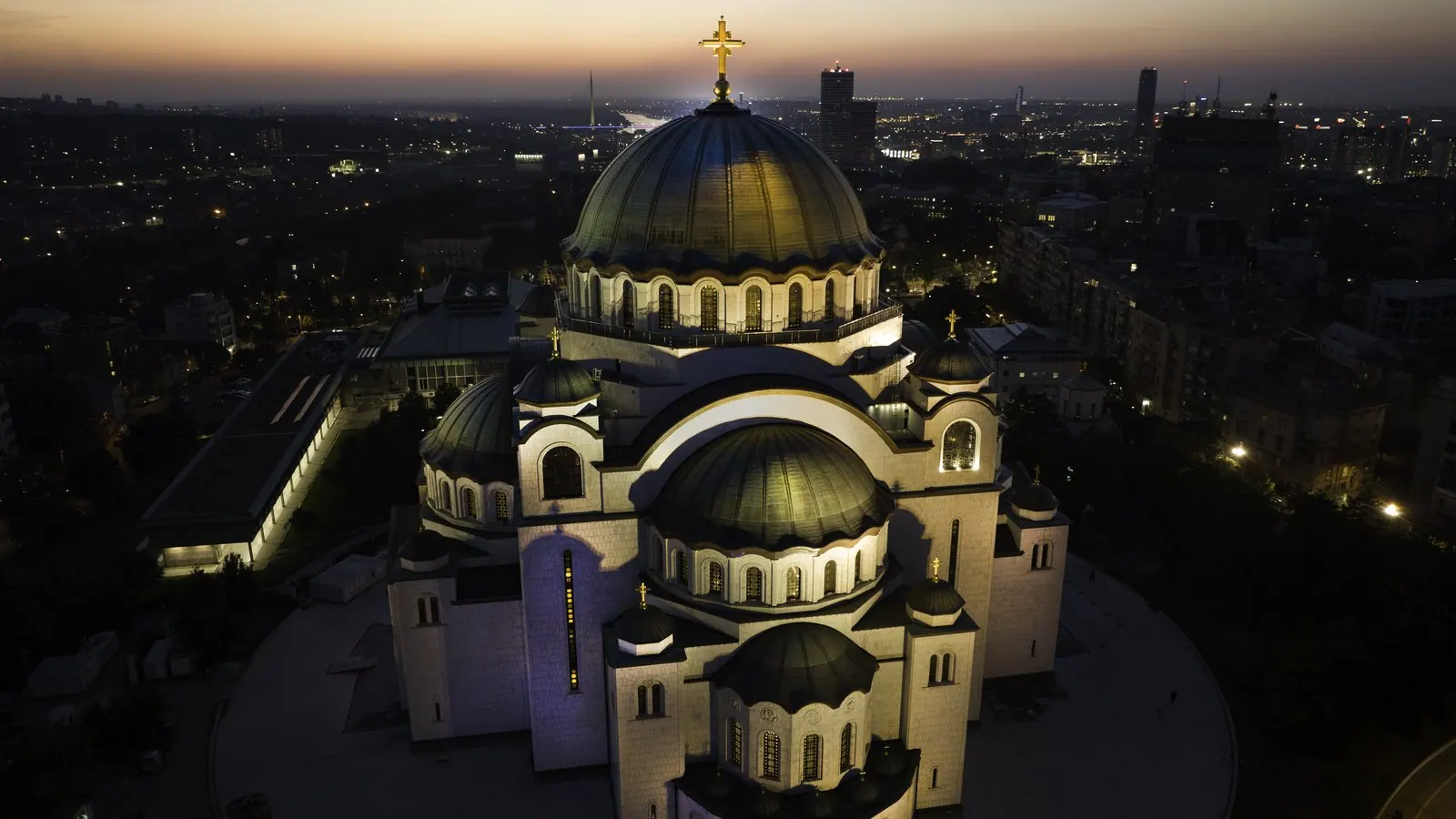
Serbia is one of the few countries in Europe where faith is still visible in ordinary life. The Church of Saint Sava in Belgrade, among the largest Orthodox churches in the world, took more than a century to finish. Studenica, founded by the father of Saint Sava in the twelfth century, is on the UNESCO list. Each family keeps its slava, the feast of its patron saint, with bread, wine and an open table. Catholics will find parishes in Vojvodina and Belgrade, and Protestants small communities.
Families matter here. Grandparents live close, children are welcome in restaurants, and Sunday lunch is long. Private and international schools exist in Belgrade and Novi Sad. For a family that wants its children to grow up near tradition without leaving Europe's geography, that is a real asset.
The law of the land asks little but asks it firmly: register your address, keep your ground for residence alive, pay the tax you owe where you are resident. Follow it and the door stays open.
Two worked examples (illustrative, not clients)
Pieter and Anouk, Utrecht. They moved to Limassol two years ago, took Cyprus tax residence and Non-Dom status, and run a small software consultancy through a Cyprus company. Box 3 at home had become a tax on paper wealth, and they wanted a second door outside the EU, close to their parents. They buy a flat in Novi Sad for EUR 140,000, register it, and file for temporary residence. They spend about 70 days a year in Serbia, mostly in summer and around Orthodox Easter, and keep their life, school and company in Cyprus. Their Serbian card is renewed on the same ground. They do not count on Serbian permanence, because their absences are too long; the card is the point.
James, Manchester. A data engineer, single, tired of a top marginal rate that starts early. He founds a Serbian d.o.o. with two colleagues from Belgrade, takes a single permit as its director and becomes Serbian tax resident. His salary bears 10% income tax plus contributions, his dividends 15%, and he files the UK statutory residence test carefully for the year he leaves. In three years he can apply for permanent residence. He has not given up his British passport and does not intend to.
Who Serbia suits
Europeans who want a nearby, inexpensive second residence they can actually use.
Owners who would rather hold a home than a deposit or an investment certificate.
Founders who will genuinely build a team or business in the region.
Families who value faith, tradition and short distances to grandparents.
Cyprus residents who want an extra door without changing their tax home.
Who it does not suit
Anyone looking for a low-tax home: Serbia taxes worldwide income, and its rates are moderate, not minimal.
People who need a second passport and cannot give up their current one.
Anyone who wants to buy a token property and never visit.
People for whom media freedom and political stability are deal-breakers right now.
Remote workers for foreign employers who want a dedicated nomad permit.
How it fits a European base
A Plan B residence works best next to a clear European base. Cyprus gives you an EU home, a defined tax position and, in time, permanent residence and a possible passport. Serbia gives you a nearby door outside the Union, a home you own and a culture many of our readers find familiar. Keep the roles clean: one tax home, one second residence, and records that show which is which. For running costs on the island, see our guide to the cost of living in Cyprus, and for the company side, company formation in Cyprus. All episodes are in our blog.
FAQ
Can I get residence in Serbia by buying property?
Yes. Ownership of real estate is a listed ground for temporary residence. The law sets no minimum value, but the home must be registered in your name in the cadastre and be where you actually live, and you need proof of means and health insurance.
How long until permanent residence?
Three years of continuous temporary residence. Absences may total ten months, or six months in one stretch, over those three years. You may file from 60 days before the three-year mark.
Does a Serbian residence permit make me tax resident?
Not by itself. Tax residence follows your home and centre of vital interests, or 183 days in any twelve-month period. If you become resident, Serbia taxes worldwide income at its flat rates.
Can I keep my Cyprus company and Non-Dom status?
Yes, if Cyprus remains your tax home in fact: your days, your home, your family and the real management of the company. Spend too much time in Serbia and the treaty tie-breaker may move you.
Can I become a Serbian citizen?
After permanent residence and three years of registered residence, but the law expects you to give up your current citizenship unless that is impossible or unreasonable. For most EU citizens that makes Serbia a residence, not a passport.
Sources
Ministry of Interior, Law on Foreigners (consolidated, incl. 62/2023, English): https://www.mup.gov.rs/wps/wcm/connect/9e10bf1d-79ad-4a50-a8c1-76b6afb0d6e9/Law+on+Foreigners+2023.pdf?CVID=pdNziNy&MOD=AJPERES
Ministry of Interior, permanent residence: https://www.mup.gov.rs/wps/portal/en/information/Permanent+residence+%28settling+or+an+indefinite+leave+to+remain%29
Ministry of Interior, Rulebook on permanent residence (Official Gazette 118/2023, English): https://www.mup.gov.rs/wps/wcm/connect/d87abf41-66df-4211-b60e-8ce19dffe31c/Permanent+residency-EN.pdf?CVID=o-reGES&MOD=AJPERES
Government of Serbia, Portal for Foreigners: https://welcometoserbia.gov.rs
Ministry of Interior, Law on Citizenship (Serbian): https://www.mup.gov.rs/wps/wcm/connect/735c0577-9c4b-46ee-9527-2e7401b14017/pdf_lat_Zakon+o+drzavljanstvu.pdf?CVID=mtru77c&MOD=AJPERES
Ministry of Foreign Affairs, citizenship: https://www.mfa.gov.rs/en/citizens/services/citizenship
Ministry of Foreign Affairs, entry with identity card (FAQ): https://www.mfa.gov.rs/en/citizens/frequently-asked-questions
Tax Administration, Law on Personal Income Tax (English): https://purs.gov.rs/upload/media/2025/11/24/760462/Law_on_personal_income_tax.pdf
Tax Administration, Law on Corporate Income Tax (English): https://purs.gov.rs/upload/media/2025/11/28/760479/Law_on_corporate_income_tax_-_Zakon_o_porezu_na_dobit_pravnih_lica_english_translated.pdf
PwC Worldwide Tax Summaries, Serbia, individual residence: https://taxsummaries.pwc.com/serbia/individual/residence
PwC Worldwide Tax Summaries, Serbia, taxes on personal income: https://taxsummaries.pwc.com/serbia/individual/taxes-on-personal-income
PwC Worldwide Tax Summaries, Serbia, income determination: https://taxsummaries.pwc.com/serbia/individual/income-determination
KPMG Serbia, annual personal income tax for 2025 income (February 2026): https://assets.kpmg.com/content/dam/kpmgsites/rs/pdf/2026/02/KPMG-Tax-Alert-Annual-personal-income-tax-for-income-generated-in-2025-February-2026.pdf.coredownload.inline.pdf
KPMG Serbia, treaty network as at 1 January 2025: https://kpmg.com/rs/en/insights/tax-alerts/2025/05/serbian-network-of-double-taxation-treaties-list-of-tax-havens-and-withholding-tax-on-services.html
Lexology, 2023 amendments to the Law on Foreigners and the Rulebooks of February 2024: https://www.lexology.com/library/detail.aspx?g=c6132258-c80a-4bb6-b76c-ebd7ef11c68d
US Treasury, FATCA agreement with Serbia: https://home.treasury.gov/system/files/131/FATCA%20-Agreement-Serbia-4-11-2019.pdf
Cyprus Ministry of Finance, double tax treaties: https://www.gov.cy/mof/en/documents/double-tax-treaties/
If you would like a second pair of eyes on how a Plan B residence fits your situation, you can write to us.
General information, not tax, legal or immigration advice. Serbian authorities decide every application.Cover photo: Petar Milošević, Wikimedia Commons, CC BY-SA 4.0, cropped.
.jpg)